An industrial immersion heater does more than raise a tank’s temperature. Its mounting connection must fit the vessel, the sheath must withstand the liquid, and the heating surface must release energy without creating damaging hot spots. Selecting only by kilowatts can lead to premature element failure, difficult maintenance or a heater that cannot meet the process start-up time.
This immersion heater Malaysia guide helps factory engineers, maintenance teams and industrial buyers compare flange and screw plug mounting, assess PTFE-clad and metallic sheath options, estimate the required heating power and prepare a technically useful quotation request. It draws on the product families listed by HQ Heating Sdn. Bhd. for water, oil and compatible chemical-bath applications.
Short answer: Choose the mounting from the vessel connection and required access; choose the wetted sheath and allowable watt density from the liquid and its operating conditions; then calculate heat-up and holding duty, specify independent protection and verify the complete heater against the supplier’s model-specific documentation.
Which Immersion Heater Should You Choose for an Industrial Tank?
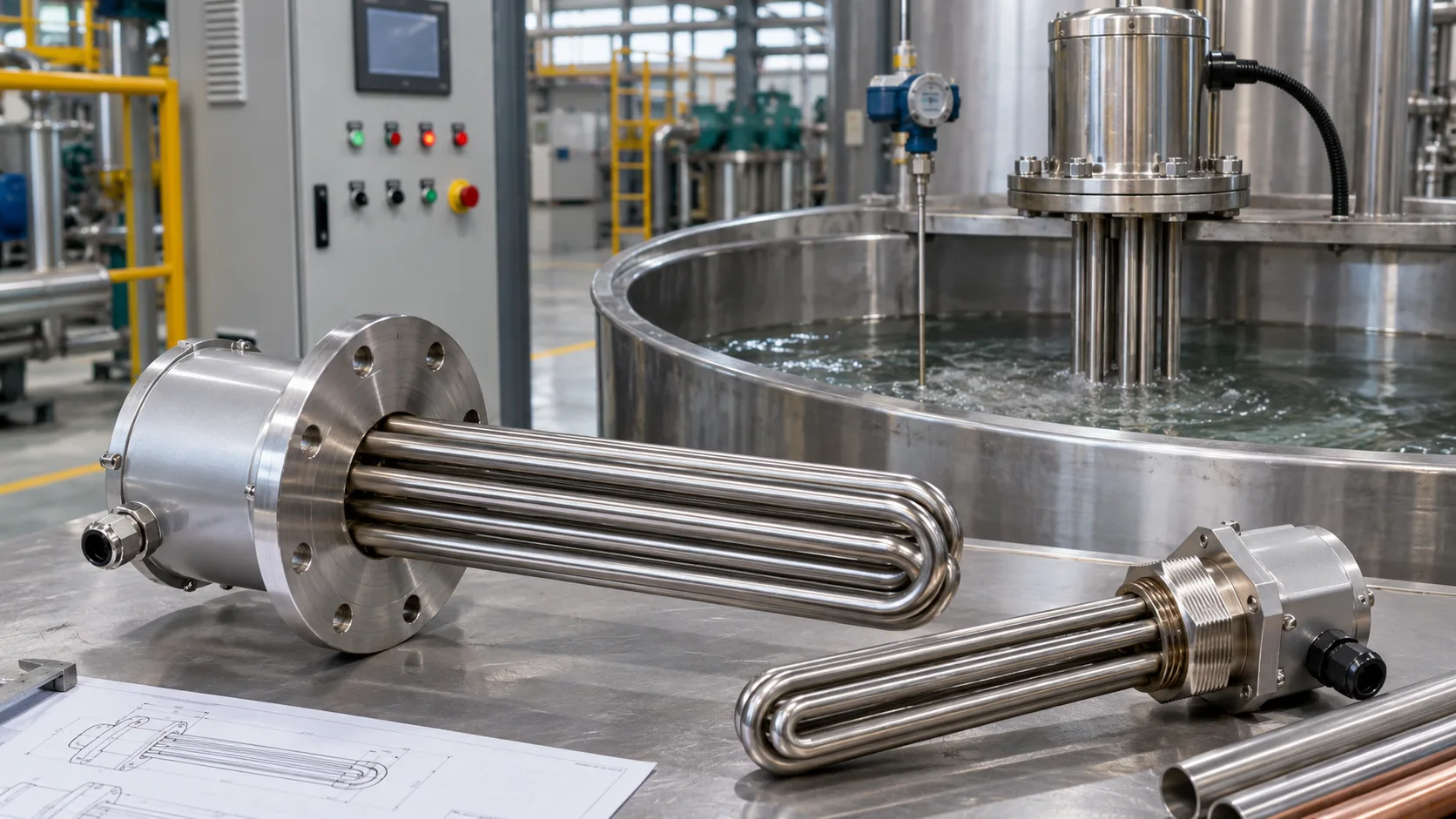
A screw plug heater often suits an existing threaded tank connection, while a flanged heater suits a compatible bolted nozzle or an engineered element bundle. For an open tank, an over-the-side design may avoid a new wall penetration. These are mechanical arrangements, not guarantees of chemical compatibility or performance.
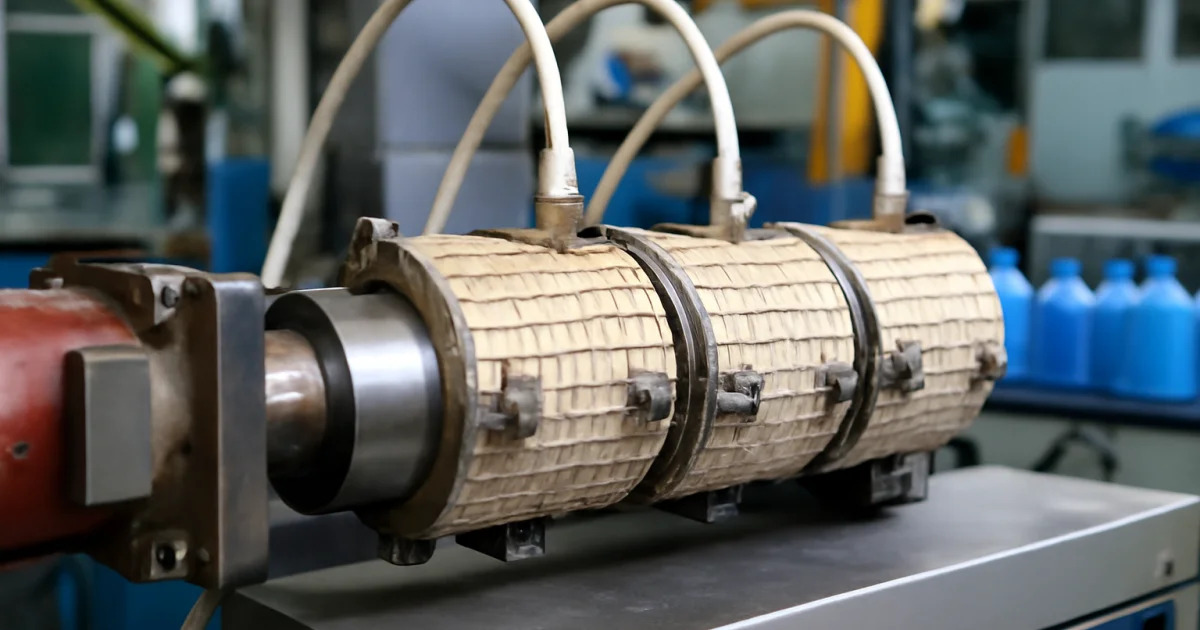
PTFE, commonly called Teflon, belongs to another selection decision: the material protecting the heating element from the process liquid. A PTFE-clad element may be appropriate for a particular corrosive solution, but its temperature limits, seals, physical construction and approved chemical compatibility must be confirmed. It is not automatically a substitute for every metallic heater.
| Design option | What it describes | When to investigate it | What to verify |
|---|---|---|---|
| Screw plug immersion heater | Threaded mounting into a matching tank coupling | Existing threaded opening, compact element arrangement or straightforward replacement | BSP/NPT thread, insertion length, seal, pressure/temperature rating and removal clearance |
| Flanged immersion heater | Element bundle mounted on a bolted flange | Tank with a mating flange, larger engineered bundle or planned maintenance access | Flange standard, nominal size, pressure class, gasket, bolt pattern and bundle clearance |
| Over-the-side heater | Element inserted from an open tank’s upper edge | Suitable open tanks where a side-wall penetration is undesirable | Tank support, liquid level, heated zone, splash exposure and removal method |
| PTFE-clad heater | A sheath or protective construction, not a mounting type | Certain chemical baths with verified material and temperature compatibility | Full fluid chemistry, sheath/termination compatibility, operating temperature, allowable surface loading and low-level protection |
HQ Heating lists a Flange Immersion Heater, a Screw Immersion Heater range, an OTS over-tank-side heater and a Teflon Immersion Heater. Review the appropriate product page before requesting a model-specific specification; the category names alone do not establish suitability for a given liquid or vessel.
Flange vs Screw Plug Immersion Heaters: What Really Changes?
The principal difference is the tank connection and the space available for the element assembly. A threaded screw plug must match an existing coupling, while a flanged bundle needs a corresponding flange and gasketed joint. Both can contain tubular heating elements. Neither design is inherently more efficient for every process.
When a screw plug is practical
A screw plug may be attractive for replacing a heater in a tank with a known threaded fitting. However, nominal thread size is not enough: confirm BSP versus NPT, the actual thread specification, sealing arrangement, immersion length and available space to withdraw the assembly. A connection that looks similar in photographs may have incompatible threads.
HQ Heating’s SIH 1-inch BSP Screw Immersion Heater page illustrates why buyers need the precise part number: its table contains different wattages, voltages and dimensions. Do not assume one SIH listing represents all screw plug models.
When a flange is practical
A flange can accommodate a specified bolted connection and an engineered element bundle, but its joint must match the vessel design. Request the flange drawing or standard, rating, gasket material and all necessary dimensional details. For a pressurised vessel or hazardous process, the responsible engineer must establish the applicable mechanical integrity and approval requirements.
Do not order a flanged heater based only on the tank’s nominal pipe size. Bolt patterns, pressure classes, facing types and insertion clearances can differ. The public HQ Heating flange heater listing confirms the product family, but a buyer still needs a project-specific drawing and approved operating data.
How Do Water, Oil and Chemical Baths Change Heater Selection?
Begin with the actual fluid composition, viscosity, operating temperature and contamination risk. These properties affect the suitability of the wetted material, the amount of heat the fluid can absorb near the sheath and the likelihood of scale, corrosion or deposits.
| Service | Main engineering concern | What the RFQ should include |
|---|---|---|
| Process or wash water | Water quality, scale, chlorides, treatment chemicals and required heat-up time | Water analysis where relevant, tank volume, flow/agitation, maximum temperature and cleaning schedule |
| Thermal oil or viscous liquid | Local overheating, oil degradation/coking and reduced heat transfer at low flow | Exact fluid grade, viscosity-versus-temperature data, minimum circulation, permitted film temperature and maximum bulk temperature |
| Cleaning, plating or chemical bath | Corrosion, concentration changes, sheath compatibility and potentially hazardous vapours | Current SDS, full mixture and concentration, operating temperature, tank material and any area classification |
| Changing or unknown fluid | Uncertain material compatibility and heater surface loading | Identify the actual fluid and conditions before final heater selection; do not substitute a generic assumption |
For instance, a heater that performs acceptably in clean water may form deposits in hard or chemically treated water. In oil, too much heat flux at the element surface can damage the fluid even while the measured bulk temperature remains acceptable. With aggressive chemical solutions, the sheath material and any exposed seals or fittings become part of the compatibility assessment.
HQ Heating’s FG260 Teflon Immersion Heater listing describes stainless steel elements with PTFE cladding, a non-heated vertical section and single-phase construction. These details are specific to the listed product. They do not establish universal compatibility with every acid, concentration or temperature, nor do they mean the heater may be exposed above the permitted liquid level.
How Do You Calculate the Required Immersion Heater Power?
Estimate the energy needed to raise the liquid temperature, divide it by the available heat-up time, then account separately for tank losses, ongoing process demand and the actual heating system. This gives a defensible preliminary requirement, not a final electrical or mechanical design.
Sensible heat energy (kWh) = Mass (kg) × Specific heat capacity (kJ/kg·K) × Temperature rise (K) / 3,600.
Ideal average heat-up power (kW) = Sensible heat energy (kWh) / Heat-up time (h).
Worked example: 500 litres of water from 25°C to 60°C
Consider a hypothetical, well-mixed tank with 500 litres of water, a two-hour heat-up target and no simultaneous process withdrawal. For an initial screening calculation, assume water mass of approximately 500 kg and a specific heat capacity of approximately 4.18 kJ/kg·K over the relevant temperature range.
| Input or result | Illustrative value | Calculation |
|---|---|---|
| Water mass | 500 kg | Approximate mass for 500 L |
| Temperature rise | 35 K | 60 – 25 |
| Specific heat capacity | 4.18 kJ/kg·K | Illustrative water property |
| Ideal sensible heat | 20.32 kWh | 500 × 4.18 × 35 / 3,600 |
| Heat-up duration | 2 hours | Assumed requirement |
| Ideal average power | 10.16 kW | 20.32 / 2 |
What this result does not include: energy to heat the vessel, pipework or fixtures; losses to the surroundings; evaporation; incoming colder liquid; heat removed by production; or any temperature-dependent changes in fluid properties. The installed system may require a higher or staged capacity, depending on an engineering heat balance. It is not correct to order a 10.16 kW element solely from this ideal result.
The US Department of Energy’s process heat overview and process heating resources emphasise that efficient heating requires attention to the whole thermal system and its losses, not just the heater element. These are general engineering resources; they are not specifications for HQ Heating models.
What Is Watt Density, and Why Can It Matter More Than Total Kilowatts?
Watt density is the electrical heating power divided by the effective heated surface area. For an immersion heater, it describes how concentrated the heat is at the element surface. Two heaters with the same total kilowatts can create different local temperatures if their effective heated areas differ.
Watt density (W/in²) = Heater power (W) / Effective heated surface area (in²). Unheated or cold sections should not be counted as heated surface; use the manufacturer’s specified definition.
HQ Heating’s screw immersion product pages demonstrate the distinction. One 2-inch BSP series is identified as 25 W/in², while another 2-inch BSP series is identified as 75 W/in². These translate to approximately 3.88 and 11.63 W/cm², respectively. They are different published surface-load series, not two universal recommendations for particular fluids.
Higher surface loading may increase the risk of local boiling, scaling, oil coking or overheating in an unsuitable application. Nevertheless, a lower number is not automatically the correct answer: it may require more element surface area, and the completed design must still fit the vessel and deliver enough process heat. Ask the supplier for an approved surface-loading recommendation based on the actual liquid, flow and temperatures.
International heater design guidance, such as JPC France’s technical immersion-heater selection guide, illustrates how surface loading and fluid movement influence element temperature. Its test conditions are not universal limits and should not be copied into an unrelated tank specification.
How Do You Select Sheath Material for Water, Oil or Corrosive Liquids?
Do not select a sheath by a broad label such as ‘stainless’, ‘Incoloy’ or ‘Teflon-compatible’. Check the actual chemical composition and concentration, temperature, water quality, expected deposits, cleaning procedure and all wetted joints. A material that works in one formulation may perform poorly in another.
In practical terms, the supplier may investigate stainless steel, suitable nickel alloys or a chemically compatible protective construction. However, an alloy designation alone does not establish its suitability for all chlorides, acids or temperatures. Equally, PTFE cladding requires validation of its maximum permitted service temperature and the integrity of seals, transitions and terminations.
For chemical or surface-treatment baths, submit the SDS together with process concentration and operating temperature information. The final assessment should consider not only the heater sheath but also the tank, mounting connection, gasket, sensor pocket and any other component exposed to liquid or vapour.
Which Tank Dimensions and Installation Details Must Be Confirmed?
The heater must fit the tank at its installed position and remain safely immersed throughout its approved operation. A correct kilowatt rating cannot compensate for insufficient insertion clearance or a heating section that becomes exposed during normal draining.
Record the tank’s internal dimensions, wall or nozzle location, normal and minimum liquid levels, element insertion length, available withdrawal space, sludge level, support requirements and flow or agitation conditions. For a flange, confirm the mating connection and gasket. For a screw plug, confirm the exact thread. For an over-the-side heater, confirm how the unit is supported and protected from mechanical impact.
Be careful when comparing product drawings: overall length, insertion length, immersion length and heated length are not necessarily equal. HQ Heating’s screw plug listings include model-specific dimensions; obtain the correct drawing before fabrication or replacement.
What Controls and Safety Protection Does an Immersion Heater Need?
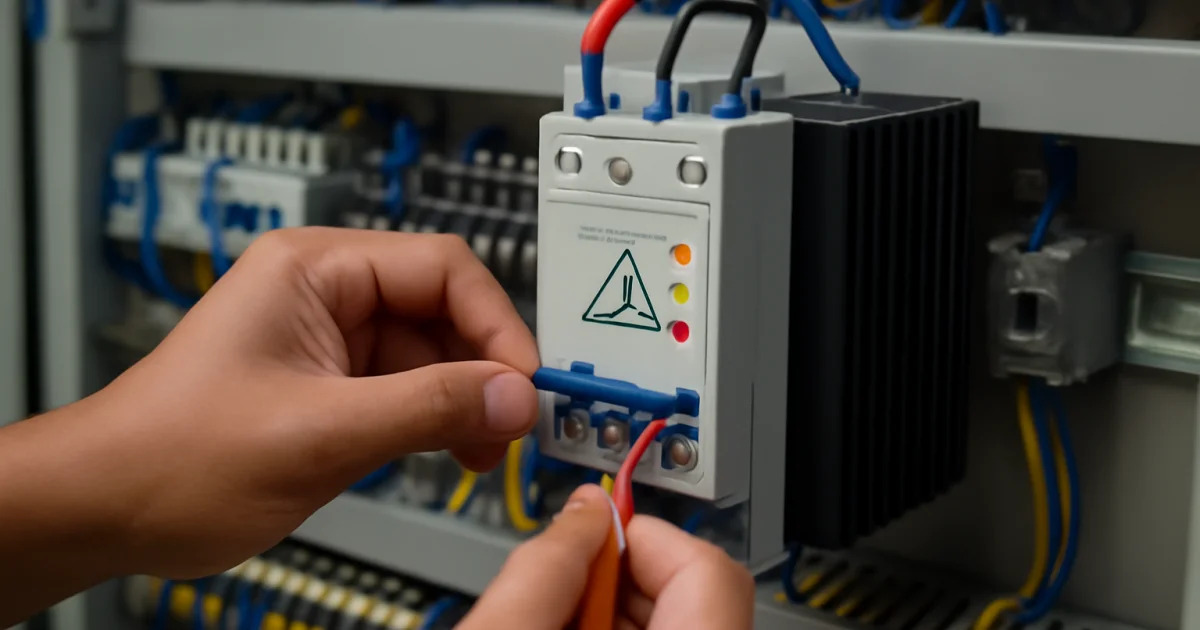
Use appropriate temperature regulation together with independently assessed protective measures for overtemperature, low liquid level and other credible faults. The exact safeguards depend on the fluid, tank, operating method and hazard assessment.
A process temperature sensor and controller may regulate normal heating, while separate protective functions prevent dangerous conditions if the control system fails. In many tank-heating applications, loss of liquid level is particularly important: an exposed heating section can overheat rapidly. Confirm the manufacturer’s minimum-immersion requirements and the site’s required shutdown response.
HQ Heating lists Level Float Switch products, a PT100 temperature sensor and a W5-Series SCR Power Regulator. These provide relevant component categories for discussion; their presence does not mean any one combination constitutes a certified heater protection system. In particular, a small level switch’s contact rating must not be mistaken for a heater power-switching rating. A competent designer must specify the appropriate control interfaces, power devices, isolation and protective logic.
Malaysia’s Energy Commission (Suruhanjaya Tenaga) installation guidance explains the requirements for registered electrical installation work and competent electrical contractors. Electrical installation, inspection and repairs should be performed by appropriately qualified personnel in accordance with the applicable rules.
For maintenance principles, the US OSHA hazardous-energy control standard explains why energy isolation, stored-energy control and verification matter during servicing. It is a US regulatory reference, not Malaysian legislation. A facility should use its applicable Malaysian requirements and site-specific isolation procedure.
Why Do Immersion Heaters Fail Early?
Premature failure is often linked to a mismatch between the heater and its service conditions, but symptoms alone do not identify the cause. A qualified technician should investigate the system safely before replacing a part or increasing the power rating.
| Observed issue | Possible contributing factors | Procurement or engineering response |
|---|---|---|
| Frequent element burnout | Low liquid level, excessive watt density, wrong voltage or failed protection | Review operating events, electrical ratings, heated surface and independent protection. |
| Slow tank warm-up | Underestimated heat load, heat loss, deposits, inadequate flow or partial heater failure | Recalculate duty and inspect performance; do not assume more kilowatts alone is the solution. |
| Scale or heavy deposits | Water chemistry, excessive local temperature or ineffective cleaning schedule | Review fluid treatment, surface loading and approved maintenance method. |
| Oil darkening or residue | Local overheating, poor circulation or fluid degradation | Check fluid properties, permitted film temperature and flow assumptions. |
| Corrosion or leakage | Unsuitable sheath, failed seals, chemical concentration changes or incorrect installation | Stop use as required, investigate compatibility and verify the entire wetted assembly. |
A visibly damaged, leaking or electrically suspect immersion heater must not be energised for informal testing. Follow the equipment and site safety procedures, including controlled isolation and appropriate inspection by qualified personnel.
What Should a Malaysian Factory Include in an Immersion Heater RFQ?
Prepare a single specification pack so suppliers compare the same duty. A photograph of an old heater helps, but it cannot replace fluid and process details.
| RFQ field | Information to send |
|---|---|
| Process liquid | Name, full composition or SDS, concentration, viscosity, contamination and cleaning chemicals |
| Heating duty | Tank volume, batch mass, initial/target/maximum temperatures, required warm-up time and holding heat losses |
| Mechanical fit | Tank/nozzle drawing, flange or BSP/NPT thread, installation orientation, insertion and removal clearances |
| Operating conditions | Atmospheric or pressure service, flow/agitation, minimum liquid level, solids/sludge and environmental restrictions |
| Electrical supply | Actual site voltage, phase, frequency, available circuit capacity and control-panel arrangement |
| Material and surface loading | Proposed sheath, fitting and gasket materials; requested supplier-confirmed watt density |
| Controls and protection | Temperature sensor, overtemperature and low-level shutdown requirements, applicable approvals and safe isolation |
| Supply and maintenance | Existing part number/photos, lead-time requirement, drawings, test records, inspection access and spare strategy |
For a replacement, record the old element’s marking, mounting geometry, insertion length, connection arrangement and actual process conditions. Do not automatically reproduce an old wattage or sheath when the earlier heater failed prematurely; investigate the cause before approving the replacement specification.
Which HQ Heating Products Support an Industrial Tank-Heating Project?
Start with the relevant product family rather than requesting a generic ‘industrial heater’. HQ Heating’s flange immersion heater and screw immersion heater products address different mounting arrangements. The FG260 Teflon immersion heater offers a documented PTFE-clad construction for applications requiring a separate material compatibility assessment, while the over-tank-side design may be investigated for suitable open tanks.
For temperature regulation, level monitoring and power control, explore HQ Heating’s listed PT100 sensor, level switch range and SCR power regulator. Final electrical and functional-safety suitability requires a complete engineered system, not a collection of compatible-looking component pages.
For broader context on electric tubular elements, see HQ Heating’s industrial tubular heater guide. Where a process calls for advanced proportional power control, its SCR controller integration article provides additional background. Those pages cover adjacent topics rather than replacing this immersion-heater selection checklist.
Conclusion: Specify the Fluid, the Tank and the Heating Duty Together
The best immersion heater for a Malaysian factory is not necessarily the largest or highest-wattage model. It is the assembly that fits the vessel, is compatible with the fluid, provides an appropriate heating surface and operates with the necessary controls and protections.
Compare flange and screw plug mounting only after confirming the tank connection. Treat PTFE or metallic sheath selection as a separate compatibility decision. Then calculate the preliminary heat-up duty, verify watt density and document the installation and acceptance requirements. This gives procurement a more reliable basis for comparing quotations and helps engineering teams avoid repeated equipment problems.
Frequently Asked Questions
Is a flanged immersion heater always more powerful than a screw plug heater?
No. A flange can accommodate certain larger element bundles, but total power depends on the actual engineered design. Multiple screw plug heaters can also provide staged capacity. Compare the required duty, tank connections, heated surface, controls and manufacturer-approved ratings rather than assuming power from mounting type.
Can a PTFE-clad immersion heater be used in every chemical tank?
No. Compatibility depends on the complete chemical formulation, concentration, operating temperature, construction details and seals. Ask the supplier to verify the selected heater against the actual bath and its maximum and minimum operating conditions; PTFE cladding alone is not universal approval.
Is a 25 W/in² heater always safer than a 75 W/in² heater?
Not automatically. These figures describe heat flux at the effective heated surface. A suitable value depends on the fluid, flow, operating temperature, deposits and overall heater design. Lower watt density can reduce local thermal stress in some applications, but the manufacturer must verify adequate capacity and physical fit.
Can I choose an immersion heater from tank volume alone?
No. Tank volume is only one input. You also need liquid properties, starting and target temperatures, required heating time, tank losses, circulation, operating duty, vessel connection and safety requirements. A preliminary energy calculation does not replace the final engineering specification.
Should a liquid-level float switch power the immersion heater directly?
Not unless a qualified designer confirms that the specific device is expressly rated and approved for that duty. Many float switches are low-power sensing components. The protective circuit, power switching equipment, independent safeguards and shutdown logic must be engineered for the actual heater and process.
Need Help Specifying an Immersion Heater in Malaysia?
HQ Heating Sdn. Bhd. lists flange, screw plug, over-tank-side and Teflon immersion heater products, alongside temperature sensors, level switches and power-control components. To discuss a suitable configuration, share the liquid details, tank drawing, voltage and phase, required heat-up time, working temperature and any existing heater part number.
Request a project-specific review of the mounting, wetted materials, watt density, control requirements and available product documentation before confirming a quotation.
Contact HQ Heating to discuss your industrial immersion heater requirements